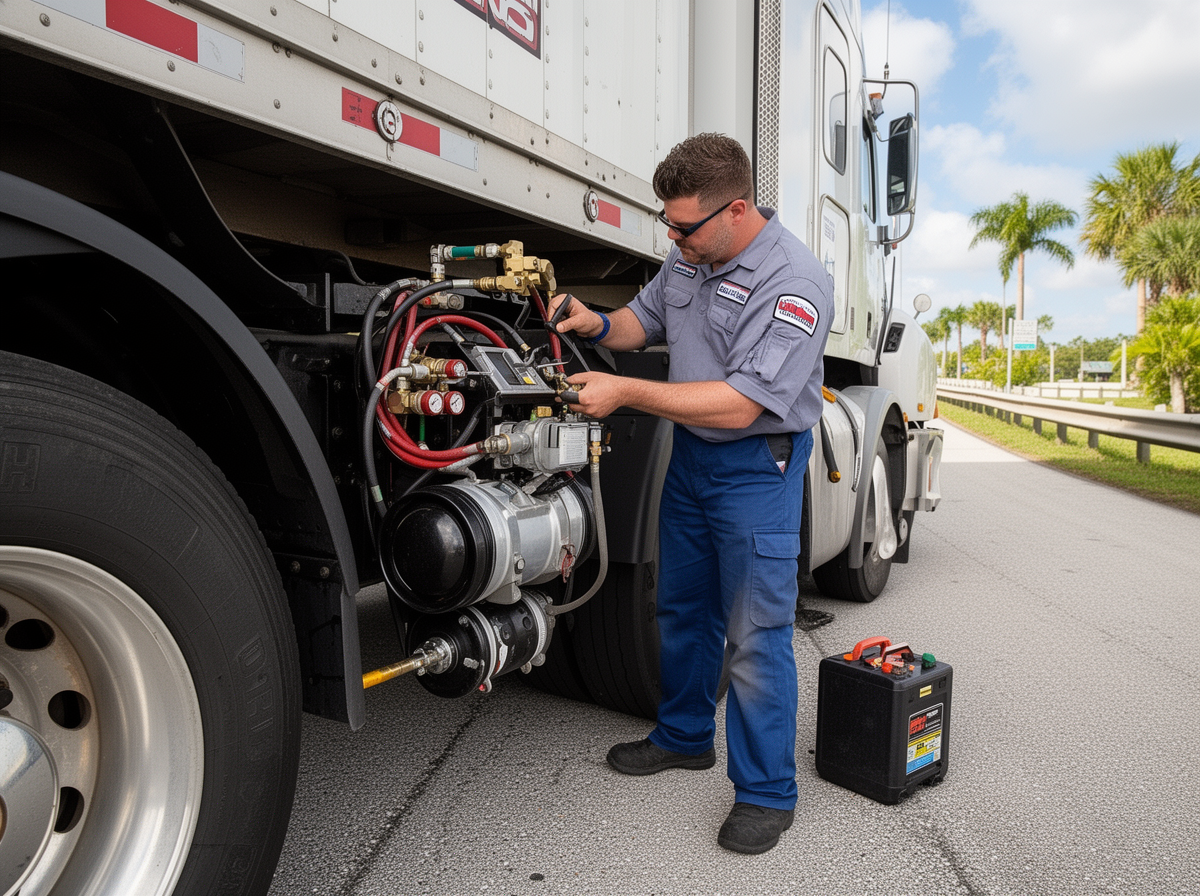
Commercial Truck Breakdown Dispatch Checklist: What to Send Before Roadside Repair
A commercial roadside repair call moves faster when the driver or dispatcher gives the technician the right information before dispatch. Mobile Truck Trailer Tire Roadside Repair provides on-site commercial truck, trailer, tire and diesel repair from separate West Palm Beach and Jupiter storefronts. This checklist can be used by drivers, owner-operators, fleet managers and dispatchers before calling for roadside service.
1. Start with the exact location
Provide a precise map pin, street address, yard or distribution-center name, highway direction, exit or mile marker, and the safest available access point. “On I-95” or “near Jupiter” is not enough. Tell dispatch whether the vehicle is on a shoulder, in a travel lane, inside a gated yard, at a loading dock, at a job site or in a parking area.
2. Identify the truck, trailer or equipment
Give the tractor, straight truck, box truck, commercial trailer or other vehicle type plus unit number when available. If a trailer is involved, identify the trailer type and whether it is loaded. Tell dispatch whether the problem is on the tractor, trailer or both.
3. For a tire call, read the full sidewall size
Do not report only the wheel diameter. Read the complete tire marking from the sidewall and identify the position: steer, drive or trailer. Verified commercial examples we service include 295/75R22.5 and 11R22.5. Commercial 15, 16, 17.5 and 19.5 applications are new-tire-only. Qualifying 22.5 and 24.5 commercial applications may be available in new, used or recap inventory, subject to exact size, position, application and current inventory.
4. Report wheel-end symptoms with the tire problem
A blowout or tire complaint can involve more than the tire. Report oil or grease around the hub or wheel, a hot hub, smoke, grinding, looseness, wheel-seal leakage, bearing noise, rim damage, brake damage or a tire that will not rotate normally. Continuing to move a truck with a wheel-end problem can make the repair larger.
5. Describe air-brake and air-system symptoms
Tell dispatch whether the truck builds air normally, builds slowly, will not reach normal pressure or builds pressure and then loses it. Report where an air leak can be heard if it can be identified safely. Mention brake-chamber leaks, a brake that will not release, an airbag or leveling problem, low-air warnings and any dashboard brake or ABS indicators.
6. For a no-start, describe what happens when the key is turned
A “no-start” can mean no crank, slow crank, normal cranking without starting, repeated clicking or an engine that starts and dies. Report battery or charging symptoms, dash warnings, recent jump-start attempts, DEF/DPF or regen messages, overheating history and any recent repair work. This helps separate battery, starter, charging, fuel, engine-management and emissions-system possibilities.
7. For trailer electrical problems, identify the failed function
Report whether the issue involves stop lamps, turn signals, marker lights, 7-way power, ABS warning, breakaway system, landing gear, liftgate, roll-up door or another component. If only one side or one circuit is affected, say so. Photos of the connector, damaged wiring or affected component can help before dispatch.
8. Send useful photos when it is safe
Helpful photos can include the complete tire sidewall size, the failed tire position, visible wheel-end leakage or damage, dashboard warnings, a damaged air line, trailer connector, broken light, liftgate or roll-up-door damage. Do not enter a travel lane or crawl under an unsafe vehicle just to take a picture.
9. Tell dispatch what changed before the breakdown
Mention a recent tire replacement, brake repair, wheel-end service, battery replacement, jump-start, regen attempt, overheating event, collision, curb strike, trailer loading issue or warning light. A short timeline can prevent unnecessary parts swapping and help the technician plan the first inspection.
10. Safety comes before roadside diagnosis
If the vehicle is in an unsafe position, there is fire or heavy smoke, a wheel appears loose, a steer tire has failed, braking is impaired, or the truck cannot be safely secured, follow the appropriate emergency and fleet safety procedures first. Mobile Truck provides roadside repair and does not provide towing.
West Palm Beach and Jupiter service resources
For commercial tire sizes and inventory rules, see: https://www.mobiletrucktrailertireroadsiderepair.com/post/commercial-truck-tire-sizes-15-16-17-5-19-5-22-5-24-5
West Palm Beach commercial truck repair: https://www.mobiletrucktrailertireroadsiderepair.com/mobile-truck-repair-west-palm-beach
Jupiter commercial truck repair: https://www.mobiletrucktrailertireroadsiderepair.com/mobile-truck-repair-jupiter-home
West Palm Beach commercial tire service: https://www.mobiletrucktrailertireroadsiderepair.com/truck-tire-repair-west-palm-beach
Jupiter commercial tire service: https://www.mobiletrucktrailertireroadsiderepair.com/truck-tire-repair-jupiter
Dispatch summary
Before calling, have five essentials ready: exact location, vehicle/trailer type, specific symptom, full tire size or warning information, and clear photos when safe. Better information before dispatch helps the roadside technician arrive prepared for the actual commercial repair need.

Comments